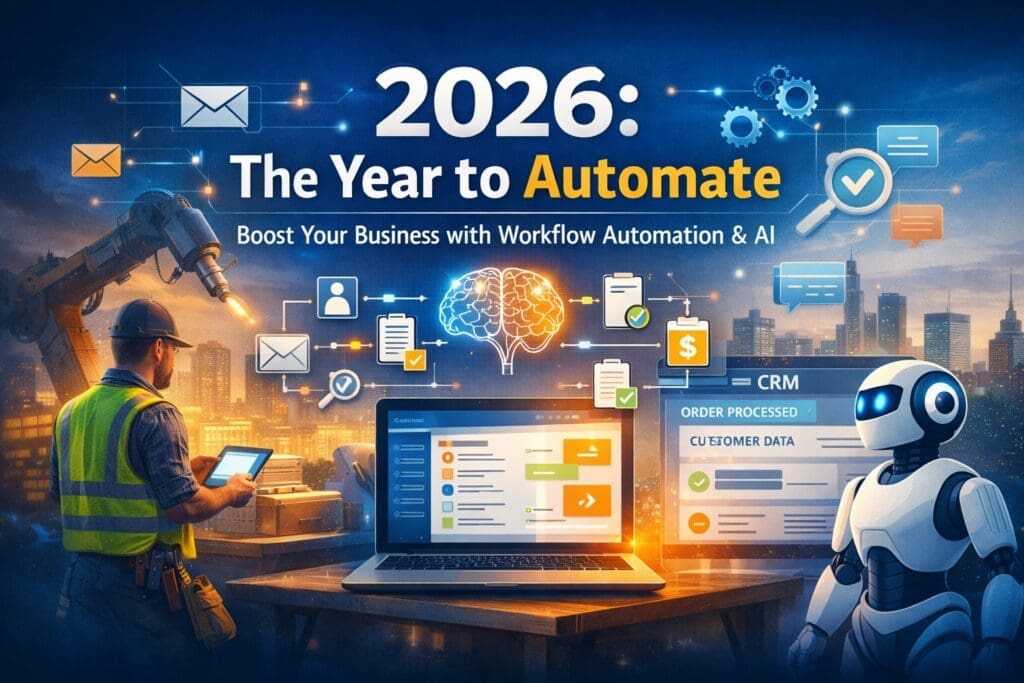
Workflow automation and agentic AI thinking are no longer “nice to have”. They are the foundation for faster service delivery, stronger margins, and better customer experience. Businesses that build these capabilities now will move quicker, serve better, and grow with less friction. Those that delay risk being outpaced by competitors who can quote faster, follow up sooner, and operate with less overhead.
What workflow automation really means (and why it works)
Workflow automation is the practice of connecting your systems and processes so routine tasks happen automatically. That could include:
Capturing leads and sending instant acknowledgements
Creating quotes and follow ups based on templates
Syncing form submissions into a CRM
Generating tasks, reminders, and reports without manual effort
Routing requests to the right person at the right time
The biggest value is not just time saved. It is consistency. Every lead is handled the same way, every time. Every job moves forward with fewer delays. Every customer gets better communication.
What “agentic AI” adds beyond automation
Basic automation follows rules. Agentic AI thinking adds decision-making and context.
An AI agent can support the workflow by doing jobs like:
Reading and summarising incoming enquiries
Checking whether a lead is a fit and asking a follow up question
Drafting customer responses using your tone of voice
Categorising requests and routing them correctly
Flagging urgent issues or high value opportunities
The result is a system that not only moves work from A to B, but also helps the business think and respond faster.
The business benefits you can expect
When workflow automation and agentic AI are implemented well, the benefits are immediate and measurable:
Faster response times, which improves conversion rates
Less admin load, which frees owners and teams to focus on delivery
Fewer mistakes from manual data entry
Better customer experience through consistent communication
Improved visibility through structured data and reporting
Easier scaling without constantly adding headcount
In many businesses, the first automation pays for itself quickly, because it removes repetitive tasks that occur every single day.
Case Study 1: A small trades business that needs speed without losing time on tools
The situation
A small trades business is busy on the tools. Leads come in from the website, Google, and social, plus calls and messages. Quotes are created manually, follow ups rely on memory, and it is easy for leads to go cold during busy weeks.
The owner wants to grow, but admin is consuming evenings and weekends.
The workflow solution
A lead and quote workflow is implemented to speed up the process while keeping the owner focused on billable work:
Lead capture and enrichment
Leads from web forms, emails, and ads are captured into a single pipeline automatically. Details are cleaned and standardised.
Instant acknowledgement and smart follow up
Customers receive an immediate response with a clear next step. The workflow asks a small set of qualifying questions based on job type.
Quote preparation support
The workflow creates a draft quote using templates and known pricing ranges, then sends it to the owner for final approval.
Automated reminders and follow ups
If a quote is not accepted within a set timeframe, the system sends a friendly follow up and prompts the owner only when needed.
Job scheduling handover
Once approved, the workflow creates the job record, sends confirmation, and updates the calendar or job management tool.
The outcome
Faster responses and quoting
Less time on admin and fewer missed leads
More consistent follow ups
Owners stay working, without sacrificing sales momentum
This is a strong example of automation doing the heavy lifting, with agentic AI assisting the decision points and communication.
Case Study 2: A service company that replaces manual order entry with an end to end workflow into the CRM
The situation
A service company receives order forms and onboarding details via email and PDFs. Staff manually enter the information into the CRM, create tasks, set up customer folders, and notify internal teams.
This creates delays, errors, and frustration. It also makes scaling harder because the process relies on admin capacity.
The workflow solution
A workflow is built that processes order forms and pushes structured data directly into the CRM:
Order form intake
Orders arrive via form, email, or file upload and are captured automatically.
Data extraction and validation
The workflow extracts key fields, checks for missing information, and triggers an automated request if something is incomplete.
CRM creation and routing
A customer record, deal, and associated tasks are created in the CRM with correct ownership and service category.
Internal notifications and handover
The relevant team receives a summary and next steps, with the full order attached and tracked.
Customer confirmation and onboarding steps
The customer receives a confirmation email, and onboarding steps kick off without manual chasing.
The outcome
Dramatic reduction in manual data entry
Faster onboarding and improved customer experience
Fewer errors and rework
A scalable process that does not require extra admin for every new customer
This is where automation becomes an operational advantage, because the system turns inbound demand into structured action quickly and reliably.
Why 2026 is the year to act
The gap between “manual businesses” and “automated businesses” is widening. Customers will increasingly choose providers who respond faster, communicate clearly, and deliver consistently. Competitors who implement workflow automation and agentic AI will:
Move quicker from lead to revenue
Serve more customers with the same team size
Reduce operational drag
Gain better insight through cleaner data
In 2026, the risk is no longer that automation might not work. The bigger risk is delaying while others build momentum.
Ready to improve your business systems?
If you want to speed up lead handling, reduce admin, improve customer experience, and build a smarter operation that scales, Wheelhouse Digital can help.
We design and implement workflow automation and AI-enabled processes that fit the way your business actually runs. Practical improvements, measurable results, and systems your team can use immediately.
Get in touch with Wheelhouse Digital today to improve your business and stay ahead in 2026.